Carpenter ants: find the nest before it reaches the framing
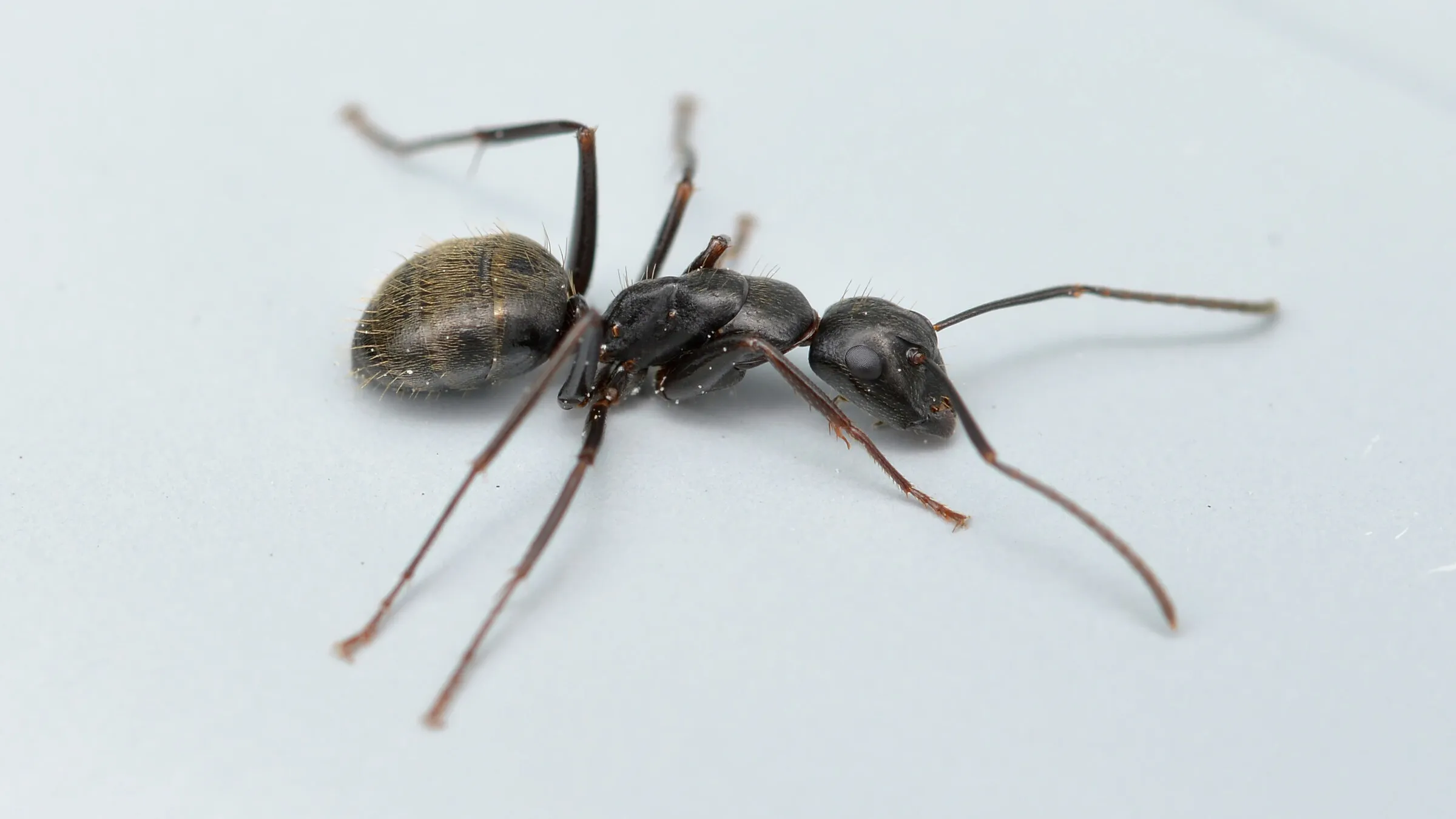

A carpenter ant does not eat wood: it excavates it to house its colony, preferably where the wood is damp. Finding them in the house in spring almost always signals two problems at once, a nest and a source of moisture. On the South Shore they are most common on the wooded lots of Saint-Bruno-de-Montarville and Châteauguay, and in the old framing of houses in Boucherville, Saint-Lambert or Vieux-La Prairie.
Identifying carpenter ants
The eastern black carpenter ant is the largest ant found in homes in the region: 6 to 13 mm for workers, more for queens. It is black, sometimes slightly reddish on the thorax, whose top forms a smooth, even curve seen from the side.
It is often confused with:
- the termite, which has a thick waist, straight antennae and four wings of equal length. Its galleries contain mud;
- the pavement ant, no bigger than 3 mm, which builds small sand mounds between paving stones;
- the pharaoh ant, tiny and yellowish, mostly in heated apartment buildings.
Signs of a colony in the structure
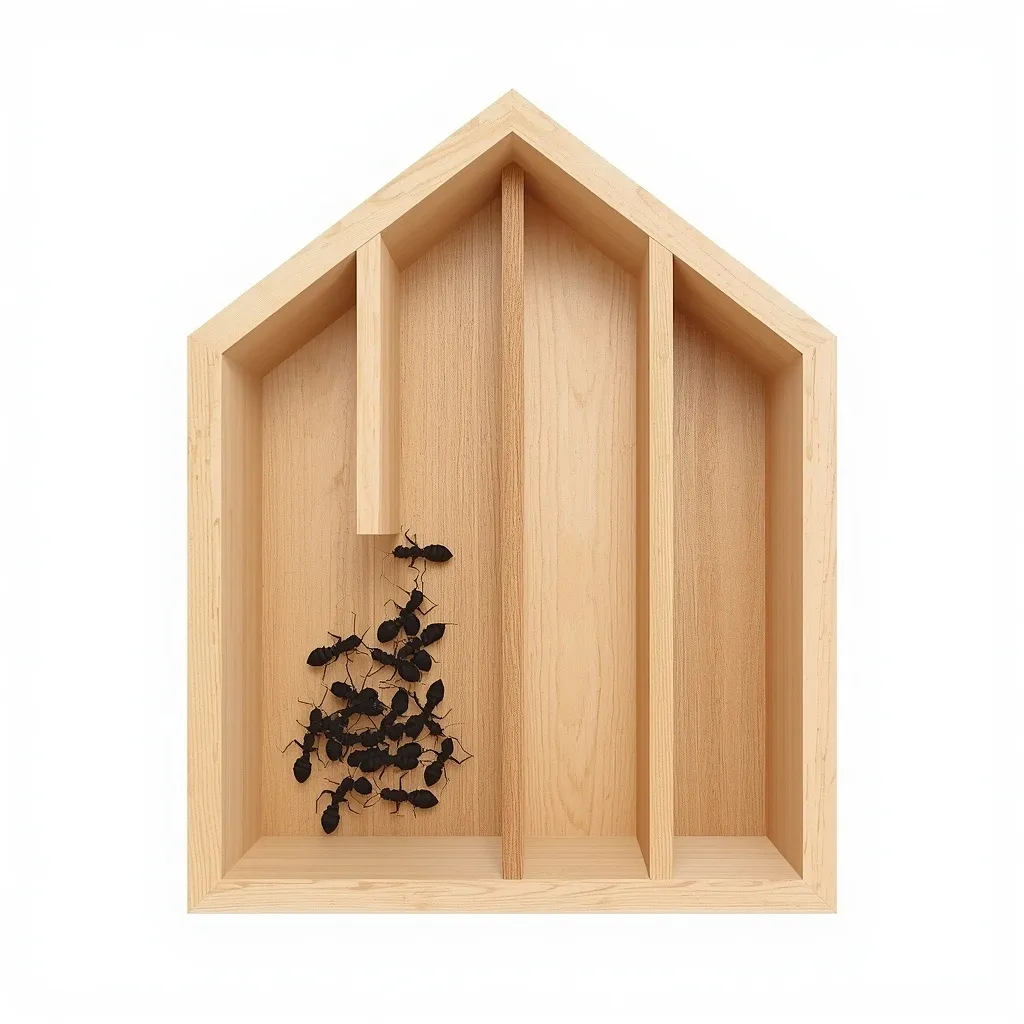
- large black ants active indoors from late winter, before the thaw;
- winged ants coming out of a wall, baseboard or window frame in spring;
- small piles of fine sawdust mixed with insect parts under a window, a beam or in the basement;
- faint rustling inside a wall at night, when the house is quiet;
- wood hollowed into smooth, clean galleries.
Winged ants indoors in spring are the most reliable sign: a colony only produces winged reproductives after several years in place.
Why act
The damage progresses slowly, but it adds up. A colony settled for several years in a sill, a deck joist or a window frame can hollow the wood well beyond what is visible. And the colony does not settle at random: it picks wood already dampened by a leak, a clogged gutter, poorly installed flashing or condensation. Treating the ants without fixing that moisture brings the problem back.
How treatment works
- Inspection. Looking for sawdust, listening at suspect spots, checking window frames, sills, decks and the yard: stumps, dead trees, firewood, branches touching the roof.
- Finding the nest. The main nest is often outdoors, in a stump or a tree, linked to one or more satellite nests in the house. Following the ants at dusk, when they are most active, helps find the routes.
- Plan. Depending on location: targeted treatment of cavities, baits, a perimeter treatment outdoors, or a combination.
- Treatment. Insecticide dusts or foams are injected into the cavities that hold the nest, through small holes drilled in the wood or drywall, and the perimeter is treated where the ants travel.
- Follow-up. A visit confirms that activity has stopped and no satellite nest was missed.
- Fixing the moisture. Gutters, flashing, leaks and ventilation: this is the part that prevents a comeback.
What it costs on the South Shore
For an accessible colony, ranges published by an exterminator serving the South Shore run $300–$800. When the nest is inside a wall or the framing and a structural inspection is needed, prices published for Montreal run $422–$1,272. Sources are detailed on the exterminator prices page.
The CD5 certificate and treatments inside walls
A treatment injected into wall cavities is a pesticide application in a living space. In Quebec, the person applying it must hold a CD5 certificate from the Ministry of the Environment. Ask to see it, ask which product is used and where the holes will be drilled, and have the quote state how long to wait before using the room again.
Preventing carpenter ants
- Keep firewood away from the house, and never store it in an attached garage or the basement.
- Remove stumps and dead trees near the building, or have them inspected.
- Trim branches touching the roof: they are direct bridges to the attic.
- Fix leaks and clean the gutters every fall.
- Avoid wood-to-soil contact: decks, fences and sheds sitting directly on damp ground.
- Watch for winged ants in April and May, when an established nest is easiest to confirm.
Ants in a restaurant, a senior residence or a warehouse call for a different approach: see commercial pest control. For the full sequence of a treatment, see how treatment works.
Frequently asked questions
Do carpenter ants eat wood?
No. They excavate it to build their nest and push the sawdust out of the galleries. They feed on honeydew, insects and sugars. That is why an active nest leaves sawdust behind rather than wood that looks eaten.
How do I tell a carpenter ant from a termite?
The ant has a narrow, pinched waist between thorax and abdomen, elbowed antennae and, in winged individuals, front wings longer than the hind wings. The termite has a thick waist, straight antennae and four wings of equal length. Termite galleries contain mud; carpenter ant galleries are clean.
I see them in the house in March. What does that mean?
Carpenter ants active indoors before the ground thaws almost always point to a nest, main or satellite, inside the heated structure of the house. In spring and summer they can also come in from outside looking for food.
Does it really weaken the house?
Slowly, but it adds up. A colony settled for several years in a damp joist, sill or window frame can dig extensive galleries. Above all, its presence almost always points to a moisture problem that needs fixing.
Are store-bought ant baits enough?
They sometimes reduce the ants you see moving around, but they rarely reach a colony inside a wall, let alone a satellite nest. Without finding the nest and fixing the moisture, the colony comes back the following spring.
Do they bite?
They can pinch with their mandibles when handled, without any real danger. They do not sting and do not transmit disease.
How long does it take to get rid of them?
Activity usually drops in the days or weeks after a well-placed treatment. A follow-up visit is often planned, because a missed satellite nest can keep activity going.
Why do wooded lots have more carpenter ants?
Because the main colony often settles in a stump, a dead tree or a damp woodpile, then creates satellite nests in nearby buildings. The large lots at the foot of Mont Saint-Bruno or along the Châteauguay River combine exactly those conditions.
Where this pest is most common
Towns in the territory where this pest puts the most pressure, based on each town’s housing and surroundings.
High pressure
Next steps
Related pests
Updated