Montreal South Shore · Montérégie
Pest control on Montreal's South Shore
Mice in a Saint-Hubert basement, carpenter ants in Saint-Bruno, bed bugs in a Longueuil apartment? Identify the pest, learn what treatment should cost and what to insist on in writing, then describe the problem: the request is routed by your town.

Ask for the CD5 certificate
In Quebec, anyone who performs or offers to perform pest control work with pesticides must hold a CD5 certificate from the Ministry of the Environment. It is valid for five years. Ask to see it before any work begins.
A written quote
Method, number of visits, price and warranty must be in writing before the work, not after.
South Shore and Montérégie
Longueuil, Brossard, Saint-Jean-sur-Richelieu, Châteauguay, Boucherville, the Richelieu Valley, Roussillon and Granby.
Towns served on the South Shore and in Montérégie
Sixteen towns across six regional county municipalities, from Châteauguay to Varennes and from Saint-Lambert to Granby. Pick yours: the quote request opens with your town already selected and is routed by that town's zone.
Longueuil agglomeration
Haut-Richelieu RCM
La Vallée-du-Richelieu RCM
Marguerite-D'Youville RCM
La Haute-Yamaska RCM
The South Shore pest calendar
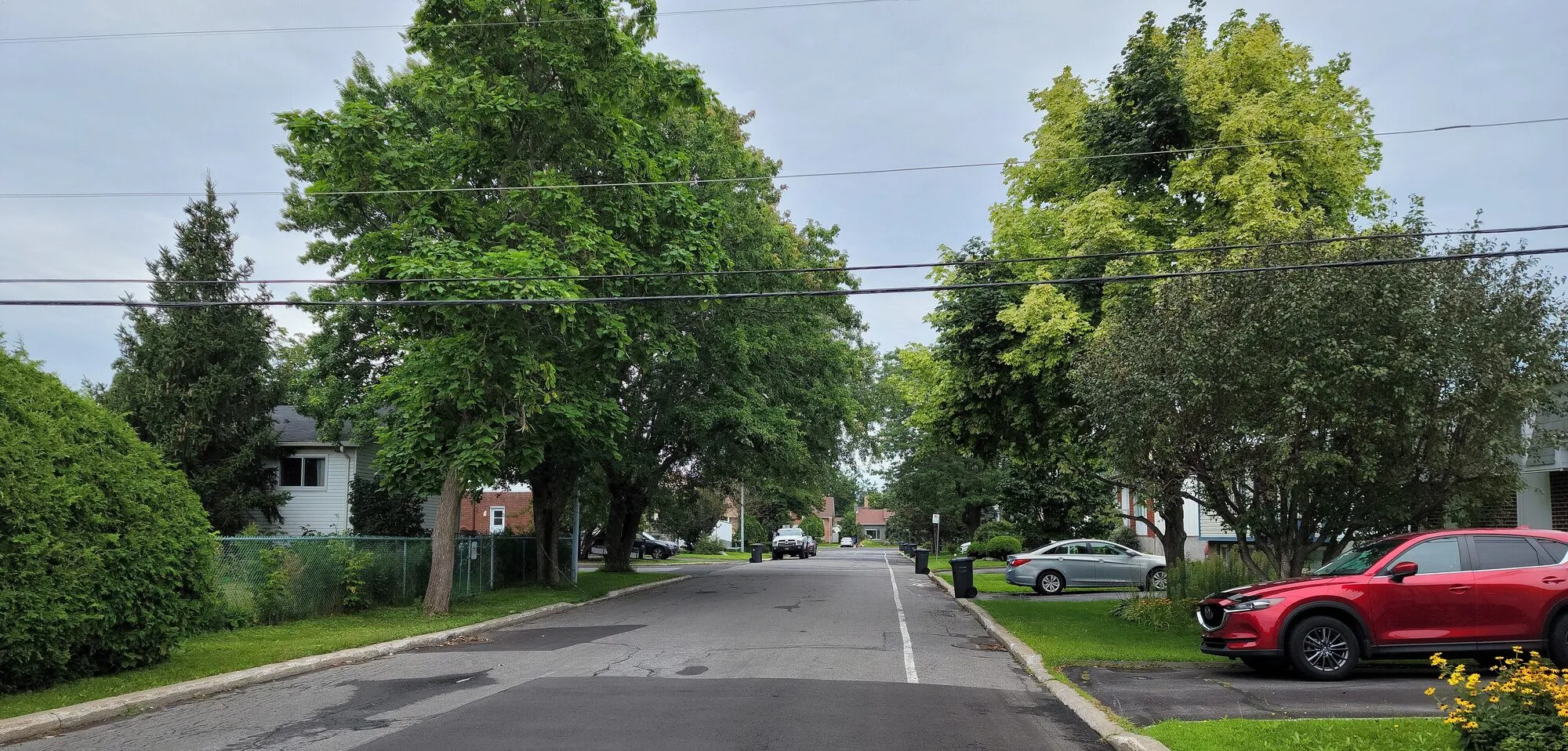
The territory mixes dense neighbourhoods, suburbs under big trees and a ring of farmland. That combination makes the pest season fairly predictable.
- Spring
- Carpenter ants become active as soon as the wood warms up: winged black ants indoors in April or May often point to a nest inside the structure. It is also the start of tick season in the woods of Montérégie.
- Summer
- Wasp colonies keep growing until August, and a quiet nest in June turns aggressive by September. Mosquitoes follow the wet areas along the Richelieu and the St. Lawrence.
- Fall
- The busiest season on the South Shore. Harvest clears the fields that surround half the towns in the territory, and mice and Asian lady beetles look for the shelter of the nearest houses at the same time.
- Winter
- Mice that already got in keep breeding in warm basements and attics. Bed bugs and cockroaches have no season at all: they travel with people and furniture.
The most common pests in the area
Each pest has its own method, timing and price. The pages below explain how to recognize it, what actually works, and what you can do before the technician arrives. Price ranges are gathered on the pest control pricing page.
Mice
They leave the fields after harvest and come in through foundations, from Saint-Hubert to Varennes. Sealing entry points matters as much as trapping.
Carpenter ants
Wooded lots in Saint-Bruno and Châteauguay and the old houses of Boucherville give them the damp wood they excavate.
Bed bugs
Most common in multiplexes and towers near the Longueuil metro, where they move from unit to unit. Follow-up visits are part of the treatment.
Wasps and hornets
Nests in soffits and behind siding on newer homes in Chambly or Saint-Constant, mostly from July to September.
Asian lady beetles
They cluster on sunny walls next to the farmland of Saint-Luc, L'Acadie and Varennes as soon as the nights turn cold.
Cockroaches
German cockroaches travel through ducts and shared walls. In an apartment building, treating a single unit almost always fails.
Rats
Norway rats around loading docks and dumpsters in industrial parks, and along the river.
Tenant or owner: who deals with it?
A large share of homes in Longueuil, Brossard and Saint-Jean-sur-Richelieu are rentals. In Quebec, a landlord must deliver and maintain a dwelling in good habitable condition, and a tenant must notify the landlord promptly of a problem such as an infestation. If nothing happens, the Tribunal administratif du logement (the housing tribunal) can be involved.
In practice, with bed bugs and cockroaches, cooperation between neighbouring units decides the outcome more than the product used. A serious quote should therefore say whether adjacent units need to be inspected. The treatment process and the frequently asked questions cover what happens before, during and after treatment.