Rats around the house: working from the outside in
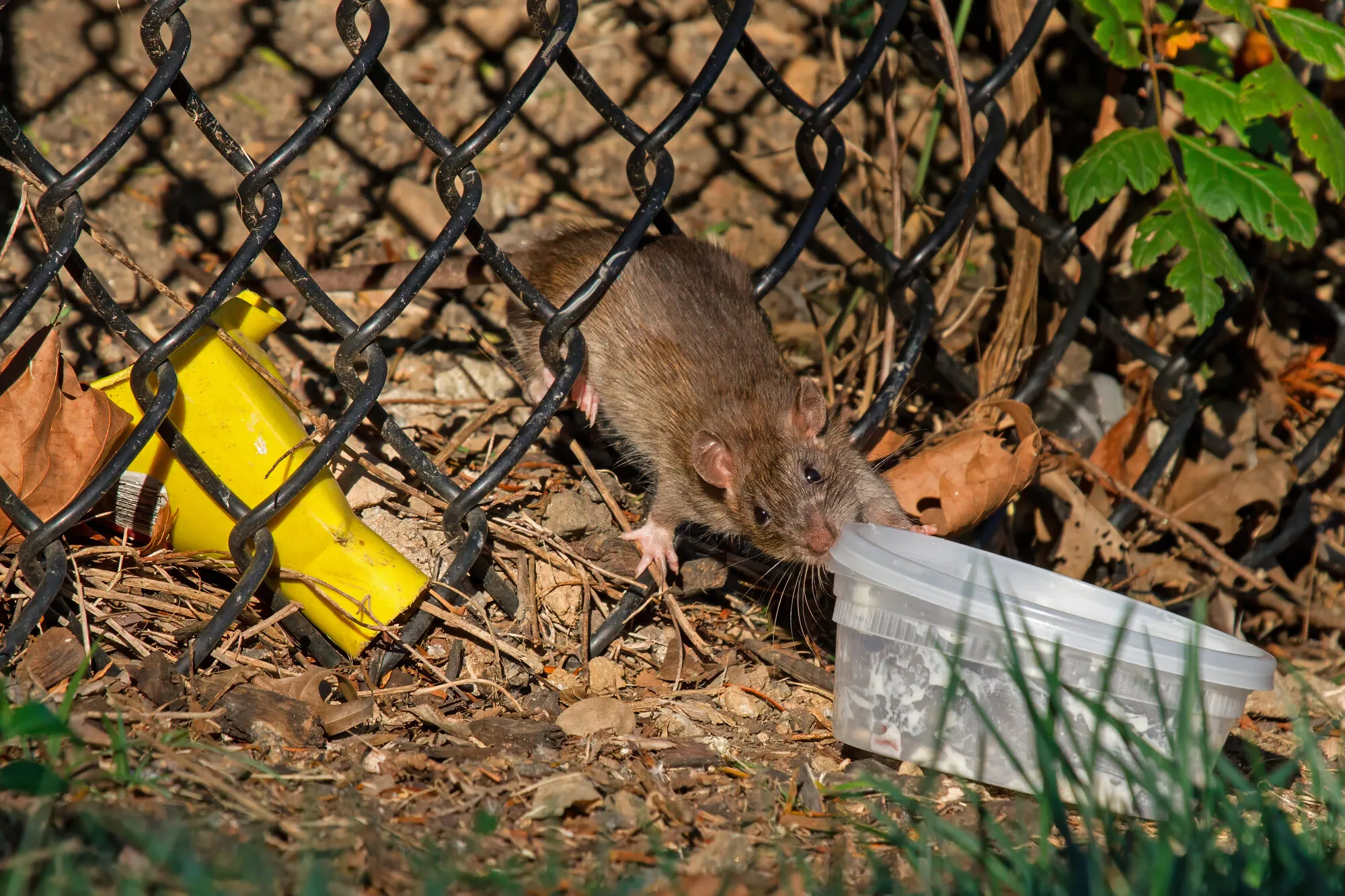

The Norway rat lives outdoors first: in a burrow dug along a foundation, under a shed or in an embankment. It only moves into a building if it finds a way in and a reason to. That is why rat problems are handled from the outside in. On the South Shore, Norway rats turn up near loading docks in the industrial parks of Boucherville or Candiac, along the river, and in yards where compost or birdseed feeds them.
Identifying the Norway rat
The body measures 18 to 25 cm, and the round, scaly tail 15 to 21 cm: a little shorter than the body. The fur is brownish grey on the back and pale grey underneath. The snout is blunt and the ears are small.
Not to be confused with:
- a mouse, much smaller, with proportionally large ears;
- a muskrat, which lives near water and has a tail flattened side to side;
- a squirrel, with a bushy tail, active during the day.
Signs of rats
- burrows about 7 to 10 cm wide along foundations, under a shed, a deck or a slab;
- capsule-shaped droppings, 12 to 18 mm long;
- trampled paths in the grass between shelter and a food source;
- compost, garbage bags or birdseed disturbed overnight;
- running noises in a ceiling that sound much heavier than a mouse;
- greasy rub marks on foundations and around openings.
Why act
Norway rats breed fast: a female can have several litters a year, often of six to twelve young. A presence ignored in spring becomes a colony by fall.
The risks are serious:
- health, because rats can transmit leptospirosis through their urine and contaminate food;
- damage, because they chew electrical wires, pipes and insulation, and their burrows can undermine the ground under a slab or steps;
- spread, because a yard that feeds rats feeds the whole neighbourhood’s rats.
How treatment works
- Outdoor inspection. Burrows, runways, food and water sources, gaps in the foundation, drains and pipes.
- Removing the food source. Compost, birdseed, pet food, garbage. Without this step, the rest fails.
- Reducing the population. Locked, anchored bait stations outdoors along the runways, or snap traps in tamper-resistant boxes near homes.
- Exclusion. Gaps sealed with metal, mesh buried under sheds and decks, drain grates secured.
- Indoors, if needed. Traps in active areas, never loose bait inside.
- Follow-up. Checking stations, confirming sealed burrows and watching for any new activity.
What it costs
Price guides published for Greater Montreal do not always separate rats from mice: they put a residential rodent treatment at $250–$695, and a two- or three-visit program at $371–$901. For a building, a business or a severe infestation, no range is published: the price is set after inspection, based on the perimeter and the number of stations. Sources are detailed on the pest control prices page.
The CD5 certificate and bait stations
A rodenticide is a pesticide, and a bait station in a yard used by children, dogs or cats is not a detail. In Quebec, the person installing it must hold a CD5 certificate from the Ministry of the Environment. Ask to see it, ask for a map of the stations and the name of the product, and have the quote state how the stations are locked and secured.
Keeping rats away
- Close the compost and set it on metal mesh; avoid meat, dairy and bread.
- Pick up fallen birdseed, or take the feeder down during treatment.
- Do not leave pet food outside, even for a few hours.
- Store wood, materials and clutter away from the foundation: they are shelter.
- Check drain grates and any gap of 2 cm or more around pipes.
- Talk to the neighbours: a rat problem is rarely solved in a single yard.
For a warehouse, a restaurant or an apartment building, see commercial pest control. If rodents are active near the electrical panel, read what to do in an emergency first.
Frequently asked questions
Are there rats in the suburbs, or only in the city?
Anywhere they find food and shelter. In the suburbs, the most common sources are backyard compost, birdseed on the ground, pet food left outside and garbage that is not properly closed.
Does compost attract rats?
An open composter, without a wire mesh base or fed with meat, dairy or bread scraps, does attract them. A closed bin set on metal mesh and limited to plant waste greatly reduces the risk.
Is rat poison dangerous for my dog or for birds of prey?
Yes, it is a real risk. A pet can eat the bait, and an owl or a fox that eats a poisoned rat can be poisoned in turn. That is the reason for locked, anchored bait stations and for preferring trapping near homes.
How long does it take to get rid of rats?
Expect several weeks and several visits: find the burrows, reduce the population, then seal the access points and check that they hold. Removing the food source speeds up the result considerably.
Can a rat come up through the toilet?
It is rare but possible: Norway rats swim well and can travel up a sewer line. Far more often, a rat gets in through a cracked foundation, a floor drain with no grate or a gap around a pipe.
How small a gap can a rat get through?
An adult Norway rat can squeeze through an opening of about 2 cm. Mesh and sealing must therefore be metal, and drain grates firmly fixed.
Do rats transmit diseases?
They can transmit diseases to humans, including leptospirosis through their urine and salmonellosis through contaminated food. Never handle a dead rat or its droppings with bare hands.
Is it a rat or a muskrat?
A muskrat lives near water, along banks, ditches and ponds, and its tail is flattened side to side. A Norway rat frequents buildings, compost and loading docks, and its tail is round and scaly.
This pest in commercial settings
Where this pest is most common
Towns in the territory where this pest puts the most pressure, based on each town’s housing and surroundings.
Next steps
Updated